

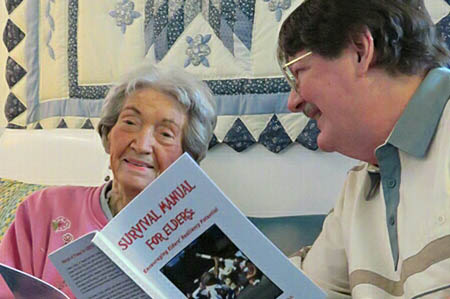
"There are those who have seen many seasons. They are the elders. There are those who have learned from the seasons they have seen. They are the Wisdom Keepers."
--Native American Proverb

For more information contact:
The Southeast Advocacy Center for Elder Rights
620 Cherokee Blvd #206
Chattanooga, TN 37405
423-875-6723
email: newseniorconcept@aol.com
Take Action – You Can Make a Difference in Protecting
Elders' Right to Live Life
Because ageist prejudice is so wide-spread in our culture, information about older adults that is actually inaccurate and biased is often just accepted as "truth". Therefore, the "system" simply continues the prejudiced attitudes, behaviors, and policies that ultimately hurt us all. Intentional activism is required to turn this around. Failure to get involved to change things guarantees that these dangerous conditions for older adults will simply continue. Listed below are specific areas of activism where your involvement can make a major difference.
We need activists in all settings, communities, churches, health care settings, businesses, government, schools, and other settings to lead educational sessions that raise the understanding of Ageism and its problems when allowed to continue. We need a large group of volunteers from all walks of life, along with funding for the materials necessary to change the understanding and expectation for elders in our nation.
II. HEALTH SYSTEM REFORM
The health care system in our country has been found by researchers to be as prejudiced about older adults as the general population, yet significantly more lethal to the welfare of elders when it occurs. Often the system, itself, is driven more by financial gain for health care providers or greater efficiency for the staff, than by delivering the best possible outcomes for older patients. more. . .
- HELP ELDERS RETURN HOME -All hospitals should be required (or coerced) to implement the Hospital Elder Life Program (HELP). This successful program focuses on: maintaining physical and cognitive functioning of older adults during hospitalization, maximizing independence at discharge, assuring a smooth transition to home, and preventing readmissions. These programs are highly successful in getting elders back home instead of sending them to long-term care, yet they are only in place in some geographic areas of the country. We need health care activists to lead the move in communities, with health care systems, and with regulatory groups to make this happen.
- DELIVER GOOD REHABILITATION RESULTS -Skilled Nursing Rehabilitation programs need to be pushed to deliver patient outcomes that enable elders to return to their homes, or at least to a lower level of care, instead of ending up in long-term nursing home care the rest of their lives. Rehabilitation programs should not be allowed to provide 100 days of therapy and then, if unsuccessful in the results they achieve, simply move the elder into the facility’s own long-term care bed – financially rewarding poor results. We need health care, community, and regulatory activists to demand, track, and share outcome data fill their long-term care beds with elder patients with who they were not successful when the person was a patient in their rehabilitation unit.
- HAVE BETTER COVERAGE FOR REHAB THERAPIES - We need better financial coverage under Medicare for home health and outpatient physical, occupational, and speech therapy – which are the keys to helping elders regain or maintain functional independence to stay in their own homes. Most professional standards find that to achieve the functional independence needed, elders need around 48 therapy sessions for each discipline required, spread over 6 months. The payment structure for therapy under Medicare generally will pay for around 24 therapy sessions for two disciplines. Speech therapy and physical therapy have to share the same session pool, even though the goals they are working on generally have little overlap. Coverage is even worse if an elder has a Medicare Advantage Plan (the private Medicare alternative). We need activist therapists, primary care providers, politicians, and voters to demand ENOUGH coverage to assure elders are able to get the therapy required to stay in their own homes successfully and to track outcomes to be sure services being provided are protecting and improving independence.
- HAVE MEDICARE COVERAGE OF EYE GLASSES , HEARING AIDS, AND OTHER VISUAL AND AUDITORY AUGMENTATIVE DEVICES -Vision and hearing problems have been found by researchers to play a major role in elder cognitive difficulty, in falls, and in the inability to successfully live alone. Appropriate and regularly reevaluated eye glasses and appropriate hearing aid fitting with professional auditory training to use it effectively make a major difference in elder independence and resiliency. Medicare does not pay for either eye glasses or hearing aids, and their cost prevents many elders from accessing them. At the same time, Medicare will pay for expensive power wheelchairs or scooters. While mobility is important, use of a power chair does not have the same positive impact on preventing serious cognitive decline that eye glasses and hearing aids can have. We need professional, elder, community, and political activists to work to get Medicare to cover eye glasses and hearing aids, and to work with the industries that produce and fit these aids to produce the most cost-effective product possible.
- CREATE NURSING CENTERS THAT ARE "HOME"-We need nursing home care that is person-centered and designed to be more like "home". Programs such as the Green House Project have shown that small group settings help elders thrive and are equally or more cost-effective than large, institutional nursing homes. We need elder, community, and political activists, along with regulators to demand that elder care honors the real sacredness of each individual, caring for them socially, psychologically, and spiritually with as much focus and intent as there currently is in physical functioning. We need activist investors who can see that great value in leading the way in developing a better future for what long-term care needs to be.
- HAVE PAID COVERAGE FOR IN-HOME ASSISTANCE -We need more alternatives to very expensive nursing home care in the form of Medicare as well as Medicaid payment for in-home care. This care needs to be required to be delivered in a way that promotes resilience and functional independence. This includes proper training of care providers in how to use "rehabilitation-based care strategies" instead of the "custodial care" typically provided by those trained as nursing assistants that inadvertently contributes to more rapid deterioration. We need community and political activists to demand paid alternatives to nursing home care and to demand new requirements for paid care givers to have the skill set they need to increase independence and resiliency instead of increase debilitation and dependency.
III. NEED FOR GREATER TRANSPARENCY AND CLARITY
People of all ages find the resources available to elders very difficult to clearly understand. As a result, many find themselves in circumstances where the choice they made was not the choice they really wanted, but it is difficult or impossible to undo the decision. more. . .
- NEED MUCH CLEARER COMPARISON OF DETAILS OF MEDICARE AND ALTERNATIVES - Medicare Advantage Plans (privatized Medicare alternatives) widely advertise with mailers and television ads offering the impression that they are better than regular Medicare. However, what they offer is much poorer coverage than regular Medicare. They sell some plans by requiring no premium payments up front. However, elders who have these plans can easily end up paying much more because they have a large co-pay for almost everything. Once an elder has had an Advantage Plan for a year, if they want to go back to regular Medicare, they may no longer qualify for a supplemental insurance plan to cover their co-pays. They have to go through underwriting and can be eliminated from coverage if they have a pre-existing condition (which most do). They are trapped in a private plan that they have discovered is not in their best interest. We need activist attorneys, politicians, insurance commissioners, elders, and families to demand clearer, easier to compare and evaluate information so that they can make appropriate and informed choices. We need to demand that the same prohibition against denial due to pre-existing conditions that is part of the Affordable Care Act also be applied to elders, and that they have a right to buy a supplemental policy anytime they get coverage from Medicare.
- NEED CLARITY ABOUT HOW HOSPICE ACTUALLY OPERATES -Hospice programs have become big business, rather than simply a caring, compassionate, end-of-life resource. Patients are recruited who are not dying. Others would not have died if they had continued routine care they were receiving for chronic conditions, instead of signing up for hospice. They die because often hospice utilizes its drug of choice, morphine, and gradually sedates the person to a comatose state. In that state they quit eating and drinking and eventually die because of it. Too many people who agree to hospice care do not realize they are giving up their right to curative or maintenance care, even for things like an acute urinary tract infection that could be cured with antibiotics. We need activist community leaders, health care providers, pastors, politicians, regulators, and concerned hospice leaders to assure highly transparent understanding of all that is being given up. Prospective hospice patients need to understand the average amount of time patients live under the care of that hospice, and the way in which their care will be managed, particularly in regards to sedating drugs. They need to understand the care they will no longer be eligible to receive and what the implications of that are. They need to be given the equally viable option of choosing palliative care for the disease they do not want to actively treat, trying to remain comfortable, while at the same time continuing to be able to treat other medical conditions that may arise.
- NEED SIMPLER ADVANCE DIRECTIVES - Advance Directives are documents many elders sign that are intended to enable them to express their wishes at the end of life. Researchers have found that many elders simply sign these under duress because they do not want "to be a burden." Most do not understand what they are actually signing away because they have limited knowledge of typical health care interventions. Most worry about being a "vegetable" and not allowed to die, but that is almost unheard of in today’s health care system. Ageist attitudes are much more likely to result in the medical system giving up on an elder prematurely. Language like "no use of tubes" or "no surgical intervention" prevents IV antibiotics or simple surgery to relieve a blood clot or other interventions that could easily enable the elder to regain their lives – simply because they did not understand what they were trying to avoid and the implications for doing so. We need activist attorneys, health care providers, social workers, and community leaders to design a new system for enabling elders to express their preferences after seeing things clearly spelled out in everyday language that is easy to understand and does not deny elders simple routine care if they would want to have it.
IV. NEED A MORE ACCURATE DESCRIPTION AND A BETTER TREATMENT PLAN FOR DEMENTIA
NEED BETTER MODELS FOR COGNITIVE ASSESSMENT more. . .
-Dementia has become a "waste-basket label" applied to an older person who appears to be having some type of cognitive (thinking) difficulty. It can be written in a medical chart based on a report from a distant daughter who says, "Mama doesn’t remember things like she used to." There is a very limited relationship between reported behavior and brain changes such as those found on an MRI. Screening tests are often given by unskilled office workers and were never designed to diagnose, but rather to indicate the need for more testing that never occurs. Because of Ageist attitudes and expectations that older people are going to have dementia, self-reports or reports of family members can be seriously unreliable. Too often a host of factors that can cause cognitive difficulty (hearing or vision loss, acute infections, cognitive impairing prescription drugs, dehydration, depression, vitamin B-12 deficiency, or even a lack of stimulation are never ruled out, but the label simply applied. The problem is that once a diagnosis of dementia appears in a medical chart, it can influence the ability of an elder to be approved for supplemental insurance, can prevent approval for rehab therapies, can prohibit the person from being able to make their own medical decisions, and can even result in being declared incapacitated and losing all rights to make decisions about where they will live, how they spend their money, and what medical care they will receive. We need activist researchers, psychologists, and therapists to change the model used to more accurately reflect cognitive difficulty, developing good evaluation tools and therapeutic and compensatory strategies. We need foundations to financially support that work. We need physicians to quit using the label "dementia" so loosely, as if it meant something. We need elders, families, and activist attorneys to challenge use of the label "dementia" and the fact that it is used to deny services that may be life-protecting or at least vital to quality of life.
- NEED MORE ACCURATE, READILY AVAILABLE INFORMATION ABOUT DEMENTIA DRUGS -Current drugs on the market, Aricept, Numenda, and Exelon are sold in large quantities for elders who have been given the diagnosis of "dementia." All of these drugs have disclaimers that they do not stop the progression of the disease and may work to slow progress, (though there is no research data that definitively shows that to be true). These medications have significant side-effects that can include: nausea, vomiting, diarrhea, loss of appetite, weight loss, dizziness, drowsiness, weakness, trouble sleeping, tiredness, body aches, joint pain, constipation, headache, swelling of hands and feet, fast heart rate, anxiety, aggression, rash, excessive urination, skin rash, redness and swelling of eyes, tremor, depression, and gastrointestinal disturbances. Facilities that work with a large number of elders often report no observable improvement on these drugs, and the side-effects can make their status much worse. They improve when the drugs are removed. These medications are extremely expensive, ranging in price from around $200 to $400 a month. Having no breakout of specific cognitive impairing symptoms and an accurate baseline for each individual, along with ruling out other factors that interfere with cognitive functioning, it is hard to determine whether or not any real improvement has occurred. We need activist elders, physicians, psychologists, and pharmacists to oversee and insist on meticulously designed and well-controlled studies of any medications routinely being prescribed for elders that are intended to improve "dementia" symptoms. We need to insist on greater truth and transparency so that elders and their families understand the very limited reported improvement and the risk of significant side-effects. The pharmaceutical companies need to quit threatening that anyone who discontinues the drug is at high risk for getting worse. Few reports of that actually occur. Elders and their families, working with their primary care providers, need to be able to make a more informed choice about the limited value before they agree to take something that is expensive with significant side-effects.
- NEED CHANGES IN SPECIALTY DEMENTIA CARE -Memory Care Units are prevalent in the senior housing marketplace. They were originally developed by the real estate industry to sell assisted living units at a higher price. Most have no special program, they just lock residents in, not allowing them to come and go. These units have no special programming or treatment. Typically, state regulations only require care givers to have one short course on dementia. The vast majority of elders with cognitive difficulty do not "wander." If they do try to go someplace, often it is simply trying to meet a need that can be easily determined and met by skilled staff. Too often these units instead resort to just sedating them with prescription drugs. There is a growing belief among experts in elder care that locked memory loss units are a type of "restraint" that violates elder rights. We need activist elders, families, and experts in geriatric care working together to change the options for care for those with cognitive difficulty. We need actual programs that help elders be the best of themselves possible, living out a normal life with meaning and purpose, not being incarcerated or sedated to "control" them. We need enlightened foundations and skilled therapeutic researchers to develop meaningful programs that maximize the resiliency and potential of elders with cognitive difficulty. We need regulatory groups to demand more of specialized programs that often make significant profits but do not improve the lives and well-being of people with cognitive difficulty.
V. PRESCRIPTION MEDICATION PROTOCOLS FOR OLDER ADULTS NEED TO BE REEVALUATED
Read more. . .
- THERE IS A NEED TO MINIMIZE USE OF COGNITIVE IMPAIRING MEDICATIONS -A large number of elders have routinely been given cognitive impairing medications for pain or anxiety. Alternative strategies such as physical therapy, massage, visualization, and psychotherapy for depression are rare. These medications often impair the elders to the point that they fall, cannot problem solve, and are not safe to live alone. Combined with other medications the elder may be taking, they can deplete the elders’ finances while also making it impossible for them to remain in their own homes. What is needed is a collaborative effort between physicians, pharmacists, psychologists, and rehab therapists to develop easy to use alternatives to cognitively impairing drugs. We need activist foundations working to fund alternative models and political activists that help shift the funding from exclusively coverage of medications to coverage of less invasive and impairing alternatives.
- NEED TO REDUCE DRUG CASCADE -Older patients are often victims of Drug Cascade. They have multiple medications, prescribed by several physicians, all interacting with one another in ways no one really understands. Rarely is anyone monitoring the whole picture, with primary care providers often reluctant to change medications prescribed by specialists. Elders, themselves, rarely look carefully at what they have been prescribed. Consequently, significant money is being spent on a number of drugs that may be interacting with each other and then require additional medications to counteract those side-effects. We need activist elders, family members, physicians, other health care providers, pharmacists, and regulators to relook at the overuse of prescription drugs for elders, finding effective ways to reduce use of medications that either are not really necessary, interact negatively with other medications, or that come with such serious side-effects that they are not worth the benefit.
Ageist attitudes are often prevalent in legal issues involving elders. The assumption is made that because they are old, they are incapacitated. more. . .
- REPEAL AGEIST DRIVING REGULATIONS - In many states, elders who have a traffic accident automatically lose their license. Sometimes this is for a period of time, such as a year. Sometimes they are required to pass the driver’s exam or a special therapeutic driving program. Elders do not have the worst traffic record, young males under 25 have that distinction. In spite of this, older adults lose their way to get around independently, just because of their age. We need activists community members and attorneys to take on these laws and challenge them as discriminatory.
- PREVENT ABUSE OF POWER-OF-ATTORNEY REQUIREMENTS -Health care facilities, physicians, and others, routinely require the Power of Attorney for elders to sign any forms regarding an elder’s care. Unless an elder has been adjudicated "incapacitated" or is comatose, they are legally able to speak for themselves. Requiring that a family member sign for them is a violation of their rights. We need activist elders, family members, health care providers, attorneys, and others to demand an end to this discriminatory practice.
VII. PROTECT SOCIAL SECURITY AND MEDICARE
we need to carefully and thoughtfully protect the Social Security and Medicare benefits elders have paid into and depend upon. The vast majority cannot afford for anyone to play with how it works to support a political or ideological belief. These programs are a life line for those who have no other pension and very limited assets. We need elder and political activists to assure this vital program is well-protected.
Philosophers and authors of sacred texts have often pointed us to the wisdom of elders – those with the most life experience. more. . .
Researchers have found that older adults have perceptual differences from those younger. They have better discernment described as "the ability to see patterns that predict future events." That discernment, based on experience and careful observation, paired with extensive experience is often missing in today’s tendency to jump to quick conclusions or believe sound bites instead of collecting and analyzing the actual data. Discounting the value of older adults in society contributes to ignoring the value of real wisdom. We need activist citizens to renew our understand and valuing of wisdom. We need the business community to step up and more fully recognize, honor, and even recruit employees and advisors with wisdom. We need pastors and teachers to renew the understanding of the role wisdom plays in not repeating failed history and in moving society to its next level of potential. We need to renew the value and help society target the goal of harvesting the wisdom money of the elders in our society have to contribute.
We need activists journalists to share these stories, to investigate the issues, and to play a major role in helping educate the public for the changes needed.
We need you, groups you are affiliated with, professional associations, and whole communities to STEP UP AND PROTECT ELDERS’ RIGHT TO LIVE LIFE.
Help us by assisting in funding the availability of training materials to help understand Ageism and make the move to Sageism.
Contact us to let us know specific areas you are willing to work on to protect and improve elder rights.The Southeast Advocacy Center for Elder Rights
620 Cherokee Blvd. #206
Chattanooga, TN 37405
423-875-6723
email: newseniorconcept@aol.com
Post your examples of Elder Resiliency on Facebook to help change the Ageist mindset that elders are "over-the-hill" especially if they encounter some type of illness, injury, or limitation. As you post it, use the label #elderrighttolivelife.
And finally, do your part to overcome Ageism that is prevalent in our society.